
Trace Camas County Former Owners
Former owners of Camas County land get rebuilt transfer by transfer. The newest deed is the starting point. From there, work backward through the recorder's grantor-grantee trail. Keep the legal description constant so the same land stays in view even when an address or parcel number changes. The table below shows the shape of a working timeline. Fill it only from actual instruments. Inventing names, dates, or book references the county never published would corrupt the chain of title.
| Transfer date | Grantor to grantee | Deed type | Book, page, or instrument |
|---|---|---|---|
| Newest recording found | Prior owner to current grantee | Copy the clerk's exact label | Record the returned reference |
| Next earlier recording | Earlier owner to the prior owner | Warranty, quitclaim, or other label | Match legal description and exhibits |
| Branch event | Estate, trustee, entity, or court-authorized parties | Probate, trustee, sheriff, tax, or corrective instrument | Link the separate case or instrument |
| Pre-1917 trail | Search names under Blaine County where appropriate | Historic conveyance or land patent lead | Ask the custodian or Idaho State Archives |
Log one row per transfer. Copy every exception, reservation, and exhibit as written. A partial conveyance, subdivision, merger, or replat can redirect the next backward step to a parent tract rather than the modern parcel.
Camas County's 2007 Digital Divide
The Camas County Recorder states that digitized copies run from 2007 forward. That year is an image floor, nothing more. It does not mark the first year indexed. It does not mean older deeds vanished. The county page offers no public index, no image viewer, and no book-and-page browser, so deed records before the digital era sit behind staff assistance. When you request a former owners search, ask directly whether staff can check index entries older than the available images. If their reach stops at 2007, ask where earlier grantor and grantee indexes, deed books, plats, surveys, or microfilm are kept and whether you can inspect them in person. The official access page is preserved in this Camas County Recorder source.
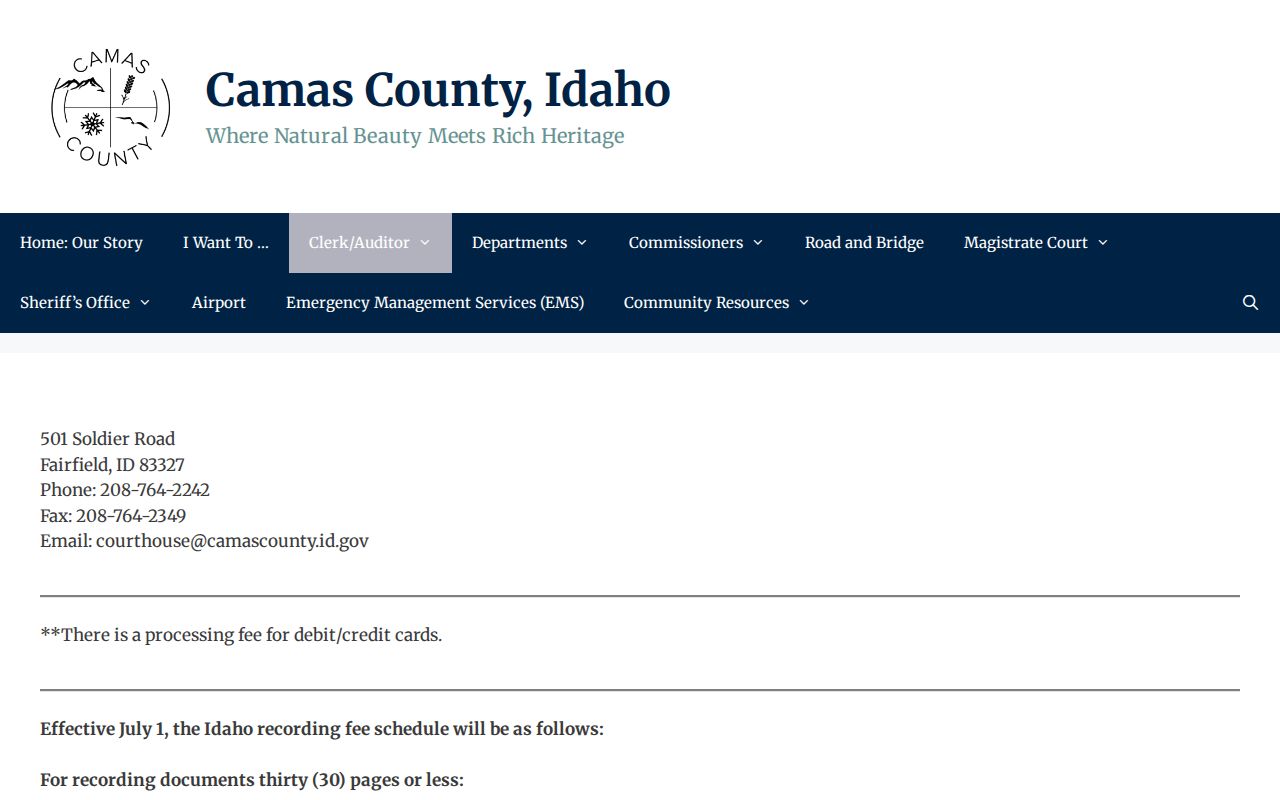
The recorder's page confirms the 2007 digitized-copy cutoff and the staff-search route. It displays no historic owner result of its own.
Coverage limit. Camas County confirms digitized copies from 2007, but the earliest deed book and historic index range remain unverified.
Reconstruct Camas County Ownership Backward
Start the backward walk with the current parcel identity and its newest grantee. Camas County offers a staff-assisted request route rather than a public search interface. So send enough detail that the clerk can follow the same land across each name change in the deed records.
- Get the current owner and full legal description from the assessor or parcel map, then request the deed where that owner appeared as grantee.
- Read the grantor from that deed and preserve its recording date, instrument number, land description, reservations, and exhibits.
- Search that grantor as a grantee in the preceding acquisition, using spelling variants and the same legal description.
- Repeat until the search reaches a probate, foreclosure, parcel split, entity change, county transition, or the limit of staff-searchable records.
- Grantor and grantee
- The transferor and recipient named in an instrument.
- Chain of title
- The ordered sequence of recorded interests affecting the same land.
- Reverse index
- A grantee-oriented route used to find how a former owner acquired the property.
- Quitclaim and warranty
- Different deed forms whose legal effect must come from the instrument, not the label alone.
Prior owners here are traced with deed records alone. For the mechanics of getting one copy, use the Camas County deed records guide.
Request Camas County Prior-Owner Fields
Email courthouse@camascounty.id.gov or write the Camas County Recorder, PO Box 430, Fairfield, Idaho 83327. In-person requests go to 501 Soldier Road. Give the address plus any historical address. Also include the parcel ID, the legal description, and the subdivision or section-township-range. Add current and former names and the instrument type. Include a date range reaching back to the first recorded instrument available.
| Request field | Why the backward chain needs it |
|---|---|
| Grantor and grantee variants | Finds initials, married names, entity suffixes, trusts, estates, and index spelling changes. |
| Legal description | Keeps the land stable when addresses and parcel identifiers change. |
| Recording date and instrument number | Orders transfers and creates a repeatable citation. |
| Book/page or image reference | Identifies the retrievable source for older and newer eras. |
| Attachments and exceptions | Reveals partial transfers, easements, plats, reservations, or surveys. |
The recorder charges a $5 search fee plus $1 per page. Searches running past two hours can add clerk wages. Confirm scope and cost first when a chain may span many names or deed books.
Camas County Chains Before 1917
Camas County was carved from Blaine County on February 6, 1917. A deed trail crossing that date may have to branch into Blaine County records. Territorial, state, or federal land records can also hold the missing link. Searching only the word Camas for earlier years can miss the custodian entirely. Ask the recorder where pre-1917 tract records and transferred indexes live. Then contact the Idaho State Archives with the full legal description, the names, the date range, and the former county. Include a precise question. Its digital collections cover only part of the holdings. The reading room is open Wednesday through Saturday, 10:00 a.m. to 4:30 p.m. An appointment at least 48 hours ahead is recommended. This county-transition quirk is genuine local history, not a sign the ownership chain broke.
Camas County Newspapers Bridge Clues
The Idaho State Archives holds Fairfield Sun microfilm from November 23, 1911 through October 16, 1913. It also holds the Camas County Courier from January 1, 1914 through December 26, 1968. Those runs can surface estate notices, sheriff's sales, tax-sale notices, and subdivision announcements. Boundary disputes and building projects tied to former owners can surface there too. Treat any newspaper name or date as a lead. Proof lives in the recorder's instruments: the deed, sheriff's deed, trustee's deed, release, or plat. When probate drove the change, the Idaho iCourt Portal may offer a later public docket trail. Older case files may still need the local clerk or the archives. Note: A dated news notice narrows the instrument search. It never proves a sale or transfer closed.
Camas County Deed Branch Events
A tidy seller-to-buyer sequence can break. Estates, divorces, foreclosures, tax deeds, sheriff's deeds, and trustee's deeds interrupt the chain. So do mergers, annexations, parcel splits, and corrections. When one appears, add a branch row to the timeline. Do not force an ordinary sale into the gap. A court caption alone does not prove title changed hands. For an entity grantee, run its exact spelling through Idaho SOSBiz. Check for filing changes. The business record can explain a name change or registered-agent trail. It does not disclose beneficial land ownership by itself. For a split parcel, compare the parent legal description against the final plat or survey. Then check the later deed's exceptions.
When Camas County Books Are Missing
Camas County has no documented courthouse fire or records-loss event. Fire is not the only risk. Some deed books sit rebound, restricted, or never cataloged. Others moved to a different repository. When a deed book or grantor-grantee index will not surface, ask the staff a neutral custody question. Ask which years were indexed, imaged, damaged, or transferred, and what terms were searched. A county page with no public portal says nothing about the clerk's shelves, and a missing sample result proves nothing either. A gap never justifies substituting another county's database.
Measure Camas County Ownership Depth
How far back Camas County previous owners can be traced has no single answer yet. Digitized copies begin in 2007. The county itself dates to 1917. Older ownership may survive elsewhere. The earliest deed-book and grantor-grantee index years were never published, so courthouse books, transferred records, Blaine County indexes, and archive holdings may still hold the older deeds. Name a cause for every gap. The cause might be a missing index entry, an unreadable or uncataloged volume, an alternate county, a confidential file, or a parcel-description change. For each former owner conclusion, record the custodian, the inspection date, the exact field or instrument, the known coverage limit, and the next verification step.
Lawful use. Camas County prior-owner research supports house history, estate work, and property diligence. Never use it to track, stalk, harass, or harm a living person.